Bee Orchid Ophrys apifera (Fr. Ophrys abeille) has a wide European distribution and frequently self-fertilises. This is thought to be the reason it produces so many varieties and aberrant forms. The species flowers in June, producing spikes of 3 - 10 flowers about 25mm across, from a rosette of leaves. The sepals are normally bright pink and the labellum formed from one larger rounded brown 'tongue' with two smaller velvety lobes which stick out at either side. They grow in grasslands of all sorts, from lawn to rough scrubby hillsides. For the full species account click here.
Normal Bee Orchid Ophrys apifera var apifera. Petals shorter than a quarter the length of the sepals. (The sepals are the three bright pink bits at the back, the petals are the two little reddish green bits at the junction of the sepals near the centre.)
Ophrys apifera var flavescens. The labellum (tongue) is yellow. This is a mutation known as hypochromatism (lacking colour), where the orchid has lost all red pigmentation and is pale.
Ophrys apifera var curviflora. The labellum is concave and the appendix at the tip (like a little yellow tongue) is visible. Normally this curves the other way, up behind the labellum, and the labellum itself is convex.
Ophrys apifera var fulvofusca. A dark red labellum, lacking the usual pattern.
More aberrations and variations will be added as I encounter them.
English Name: Snakeshead Fritillary (Lily family).
French Name: La Fritillaire pintade (='the guinea fowl fritillary').
5 Key Characters:
single flowers (occasionally 2) per stem.
flowers droop.
flowers have a pale pink and brownish-purple chequerboard pattern, and are shaped like an origami box (3-4 cm long).
grows in grassland that is flooded or very damp in winter.
leaves long and narrow, not very abundant (4-6), up the flower stem but no basal rosette.
Lookalikes: None.
Habitat: Meadows, especially those which are flooded in winter, usually along watercourses. Generally in full sun but shade tolerant.
Flowering Period: April-May.
Status: Rare but locally abundant. The bocage in the area where the Vienne and the Loire meet is one of this plants last strongholds. Thousands of plants flower here every spring. They can also be seen in the valleys of the Claise and Creuse rivers, and in the Brenne. Can be seen within 5 km of Preuilly sur Claise. Protected. Photographed by Loire Valley Nature:
Fritillaries growing in bocage pasture in the Véron (the triangle of land formed by the Vienne meeting the Loire River).
Growing in a roadside ditch between Le Petit Pressigny and Le Grand Pressigny.
Growing in a roadside ditch between Le Petit Pressigny and Le Grand Pressigny.
Growing on an island in the Indre River at Pont de Ruan.
Turned upside down to allow a view inside the flower.
,Photographed in late March 2018 in the grounds of the Connétable Thermal Spa Hotel in La Roche Posay.
Scientific Name: Lamium galeobdolon (Lamiaceae). English Name: Yellow Archangel; Artillery Plant; Aluminium Plant; Yellow Dead-nettle (Mint family).
French Name:Lamier jaune (='yellow dead-nettle'); Ortie jaune (='yellow nettle').
5 Key Characters:
square stemmed.
butter yellow hooded tube flowers (2cm long) which sit in whorls around the stems.
long oval dark green leaves with a pointed tip and toothed edges.
40-80cm high.
favours damp shady places.
Lookalikes:
Habitat: Hedges and woods.
Flowering Period: April-May-June.
Status: Widely cultivated (cultivars tend to have larger flowers and variegated leaves). Widely distributed, but uncommon in the wild now. Photographed by Loire Valley Nature:
Scientific Name: Ranunculus sardous. English Name: Hairy Buttercup; Sardinian Buttercup.
French Name: Renoncule de Sardaigne (= 'Sardinian Ranunculus'); Renoncule des mares (='pond Ranunculus').
5 Key Characters:
hairy leaves and stems.
leaves divided into 3 leaflets.
flowers bright yellow with (usually) 5 petals and 5 reflexed (downturned) sepals.
seedhead is a bobbly sphere.
10-50cm tall.
Lookalikes: Other grassland buttercups, the most common of which are bigger plants altogether.
Habitat: Damp pasture, trampled pond edges, wet hollows, roadsides, farm tracks, gateways. Places where the soil is neutral and the ground is damp and disturbed and the grass sparse.
Flowering Period: May-June-July-August.
Status: Uncommon. Supposedly the origin of the word 'sardonic', a reference to the 'bitter grin' one makes after having eaten it but just before dying (like all Ranunculus spp it is toxic).
In cool damp woodland near the Loire River in the Touraine you can find patches of wild Gooseberry Ribes uva-crispa (Fr. Groseillier à maquereau) and Red Currant R. rubrum (Fr. Groseiller à grappe). These are genuinely wild populations and not garden escapees.
Gooseberry and Red Currant growing together in woodland on the Puy Besnard near Chinon.
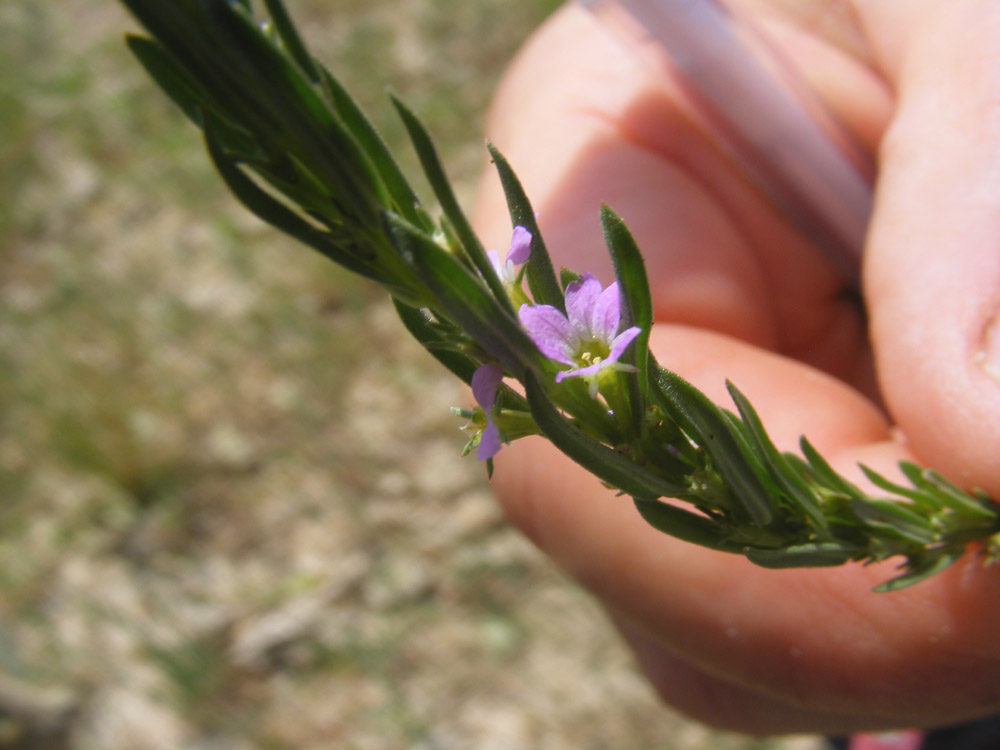
Scientific Name: Lythrum hyssopifolia. 'Hyssopifolia' means 'hyssop like leaves'. English Name: Grass-poly; Hyssop Loosestrife (Loosestrife family).
French Name: Lythrum à feuilles d'hyssope (='hyssop-leaved loosestrife').
5 Key Characters:
upright, up to 60 cm tall.
narrow oval leaves (3 cm long).
5-6 petalled single pink flowers (5 mm across) in leaf axils.
Lookalikes: Knotgrass Polygonum aviculare, which has 2-3 flowers in each leaf axil.
Habitat: Marshland, damp fields, ditches. Disturbed ground which is wet in winter and dry in spring, often grows in wheel ruts in arable fields and similar microhabitats.
Flowering Period: May-June-July-August-September.
Status: Never abundant and now rare. Threatened by modern agricultural drainage of fields and by herbicides. Photographed by Loire Valley Nature:
The first Cowslip of spring, photographed in March.
5 Key Characters:
10-30 flowers in a head, spread in all directions, not just drooping to one side.
petals apricoty yellow with orange streaks.
flowers are cup shaped and fold down into a tube.
flowers are held in a downy, blunt oval toothed calyx.
very wrinkled leaves.
Lookalikes: Some hybrid garden primulas.
Habitat: Meadows, grasslands, open woods on basic or calcareous soils.
Flowering Period: March-April-May.
Status: Common. Photographed by Loire Valley Nature:
Cowslips in the lawn at the Chateau of Candé, near Tours. The chateau grounds are run as a nature reserve and the lawns are full of wild flowers, including several species of orchid.
Photo taken mid-March.
In the lawn at friends house, in late February.
A group of cowslips in a lawn, including some which have mutated to have red flowers. This is a reasonably common mutation.
Lookalikes: Meadow Buttercup R. acris and Creeping Buttercup R. repens, neither of which have the reflexed sepals.
Habitat: Lawns, pasture, fields, hay meadows, grassy banks. Favours nutrient-poor, well drained soil, dislikes crops and improved grassland.
Flowering Period: April-May-June-July.
Status: Abundant. Poisonous when fresh but the toxin is destroyed if the plant is dried (eg in hay).
References and Further Reading: A blog post on Days on the Claise which describes how to use buttercups to calculate the age of a grassland. Photographed by Loire Valley Nature:
Scientific Name: Lathyrus linifolius (Fabaceae). English Name: Bitter Vetch; Heath Pea (Pea family).
French Name: Gesse à feuilles de lin (='flax leaved legume').
5 Key Characters:
leaf stems are winged.
flowers start out pinky-red and turn blue as they age.
seedpod long and red-brown.
15 - 30 cm tall, erect.
leaves divide into 2-4 pairs of leaflets.
Lookalikes:
Habitat: Damp rough grassland on neutral or acidic soil, open deciduous woodland, forest edges, hedgerows, grassy banks.
Flowering Period: May-June-July.
Status: The tubers contain a substance which suppresses thirst and hunger pangs. It is declining as pasture is 'improved' and and meadows ploughed up. References and Further Reading: Bitter-vetch post on Days on the Claise.
Photographed by Loire Valley Nature:
On the side of a gravel track, between pasture and forest, near Chaumussay.
Scientific Name: Aristolochia clematitis (Aristolochiaceae). 'Aristolochia' means 'best childbirth' and 'clematitis' means 'clematis-like'. English Name: European Birthwort (Birthwort family).
French Name: Aristoloche clématite (='clematis birthwort').
5 Key Characters:
twining plant that will creep over and climb up surrounding vegetation to about 80 cm.
leaves large (up to 10 cm across) and heart shaped.
flowers rather small and inconspicuous, pale yellow, but a distinctive trumpet shape.
unpleasant smell.
seedpods fat, pear shaped, hanging.
Lookalikes:
Habitat: Dry, hot, alkaline soil, rocky or sandy places, in vineyards.
Flowering Period: May-June-July-August-September.
Status: Widespread but uncommon. John Robertson points out on The Poison Garden that this is one of the most poisonous plants and has probably caused more harm than any other, partly due to the mistaken belief in the Doctrine of Signatures which led to a plant with a uterus shaped flower being prescribed by herbalists for childbirth. In fact it leads to renal failure and urinary tract cancer. It has also caused similar problems in modern times when the seeds of this and related species contaminate cereals or are included in traditional Chinese medicines. Photographed by Loire Valley Nature:
Scientific Name: Corrigiola litoralis (Caryophyllaceae). English Name: Strapwort (Carnation family).
French Name: Corrigiole des grèves (='little shoelace of the shingle').
5 Key Characters:
found on gravel river banks.
a tiny inconspicuous plant.
tiny white flowers.
grows as a flat rosette.
Lookalikes:
Habitat: Sandy gravel banks in lowland rivers with fluctuating water levels (exposed in summer, flooded in winter). Farm tracks, rural footpaths. Requires the habitat to be disturbed (eg by cattle trampling).
Flowering Period: June-July-August-September.
Status: Uncommon.Can be threatened if water levels stabilised, or if plants such as Common Reed Phragmites australis or Common Nettle Urtica dioica take over the habitat. It can't compete with other taller plants in the vicinity. Its presence on the Loire River sands reflects the river's connection with the Atlantic seabord.
Scientific Name:Saponaria officinalis (Caryophyllaceae). The specific name 'officinalis' indicates that the plant had a use, often medicinal, but can be culinary or other (in this case the plant can be used like soap).
English Name: Soapwort (Campion family). Also Bouncing Bet; Crow Soap; Wild Sweet William; Soapweed; Boston Pink. The suffix 'wort' (pronounced to rhyme with 'Bert' not 'wart') indicates that the plant has a traditional use, usually medical, but can be culinary or other (in this case, the plant can be used like soap).
French Name: La Saponaire officinale (='medicinal/working suds maker'); also la Savonnaire (='soap maker'), la Savonnière (='soap maker'), la Saponière (='suds maker'), l'Herbe à savon (='soap plant'), l'Herbe à foulon (='fulling plant'), le Savon des fossés (='ditches' soap'), le Savon de fosse (='ditch soap').
5 Key Characters:
Clusters of pink flowers about 2.5 cm across.
Occurs in patches which can be some metres across.
Often found along ditches.
Flowers scented (more strongly at night).
A robust erect plant 30 - 90 cm high.
Lookalikes: Dames-violetHesperis maronalis, which has darker, toothed leaves and violet flowers.
Habitat: Hedgerows, roadsides, waste ground.Dry rich sites and sand.
Flowering Period: July-August-September.
Status: Quite common and conspicuous.
Photographed by Loire Valley Nature:
Growing around a culvert on the roadside on the outskirts of Preuilly sur Claise.
Close up of flowers.
The stamens of the flower on the right has been infected with a fungus, turning the pollen dark and compromising its functioning. The infected
plant doesn't die though, as it will spread by runners as well.
Scientific Name: Morus alba (Moraceae). English Name: White Mulberry (Mulberry family).
French Name: Mûrier blanc (='white mulberry tree').
5 Key Characters:
small to medium sized tree.
generally young trees have long deeply lobed leaves, older trees have smaller unlobed leaves, but individual trees are very variable and can have multiple forms on the one tree.
leaves pale and thin.
deciduous.
fruit can be white, pink or deep purple, sweet and bland, July - September.
Lookalikes: Black Mulberry M. nigra, which has darker, thicker leaves all of one shape.
Habitat: The banks of the Loire, close to the old silkworm production areas and troglodyte caves which were used in the industry.
Flowering Period: April-May.
Status: Widely cultivated in the past for the production of silkworms in the Loire Valley. Now an uncommon naturalised non-native in the wild. Photographed by Loire Valley Nature:
Scientific Name: Cuscuta epithymum (Convolvulaceae). English Name: Dodder; Common Dodder; Clover Dodder; Hellweed; Strangle-tare (Morning Glory family).
French Name: Cuscute du thym (='thyme dodder').
5 Key Characters:
reddish (can be yellow or purplish) threadlike stems (0.25 - 0.45 mm diameter) that twine counter-clockwise.
grows extremely rapidly in an erratic and irregular way.
flowers pinkish white, scented, stemless, in globular flowerheads.
rootless (attaches to host plant with a sucker) and entirely parasitic, especially on heather, gorse, clover, and members of the solanum (potato) family.
leafless (leaves reduced to tiny scales).
Lookalikes:
Habitat: Parasitic on a wide range of low growing plants, ultimately relying on disturbance of habitats to enable germination of seeds over long periods of time (disturbance is often in the form of regular management of a site).
Flowering Period: June-July-August-September.
Status: Locally common. Photographed by Loire Valley Nature:
Scientific Name: Fagus sylvatica (Fagaceae). English Name: Beech (Beech family).
French Name: Hêtre.
5 Key Characters:
large deciduous tree (30 m + high).
smooth grey bark.
red-brown cigar shaped buds.
oval barely toothed leaves 4 - 9 cm long, coming to a point, on stalks, with obvious veins at the edges.
edges and veins underneath leaves with soft fine hairs.
Lookalikes: Young leaves easy to mistake for HornbeamCarpinus betulinus, but Hornbeam has jaggedly serrated leaves. Hornbeam has winged tassle like seed capsules, Beech has nuts enclosed in a scaly woody cup. Hornbeam is considerably more abundant in this area.
Habitat: Damp chalk, limestone, sandy or loamy woodlands.
Status: Uncommon and localised. Some parcels of mixed Beech and Sessile OakQuercus petraea can be found around the Pas aux ânes and Carrefour du Conservateur in the Forest of Loches. The odd isolated mature tree in Downy OakQ. pubescens woodland near Panzoult. Sometimes planted as a specimen tree in chateaux parks, but essentially the climate in the Touraine Loire Valley is slightly too hot and dry for Beech to thrive. Although widespread throughout France, there is a striking lacuna in the national distribution map, for the départements of Indre et Loire and Loir et Cher (and on the Mediterranean plain), where the species is rarely recorded.
Photographed by Loire Valley Nature:
Mixed Beech and Sessile Oak woodland in the Forest of Loches.
Visit a Chateau in the Loire Valley at Christmas
-
Seven of the historic Loire Valley chateaux participate in a campaign known
as 'Christmas in Chateaux Country'. The shining star amongst these is the
Cha...