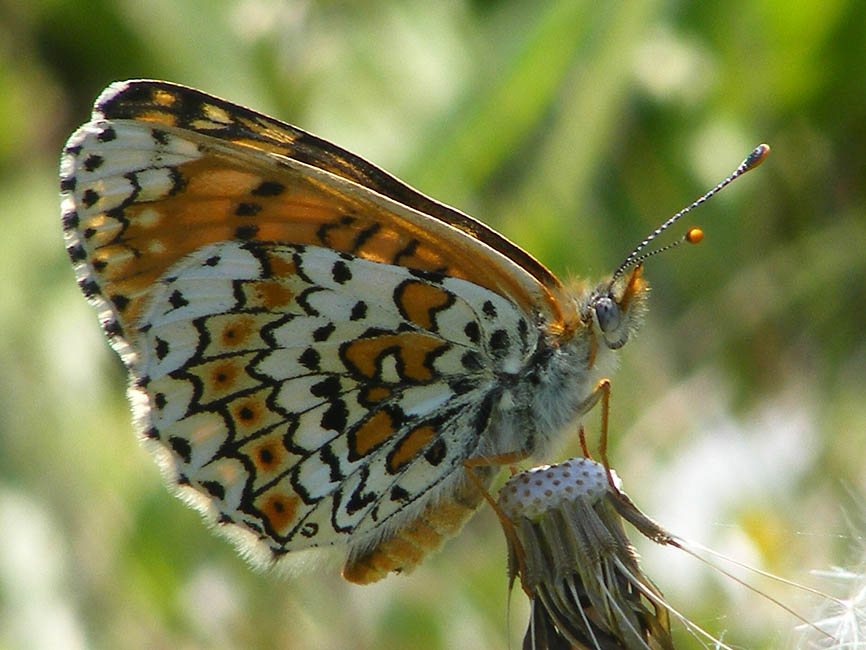
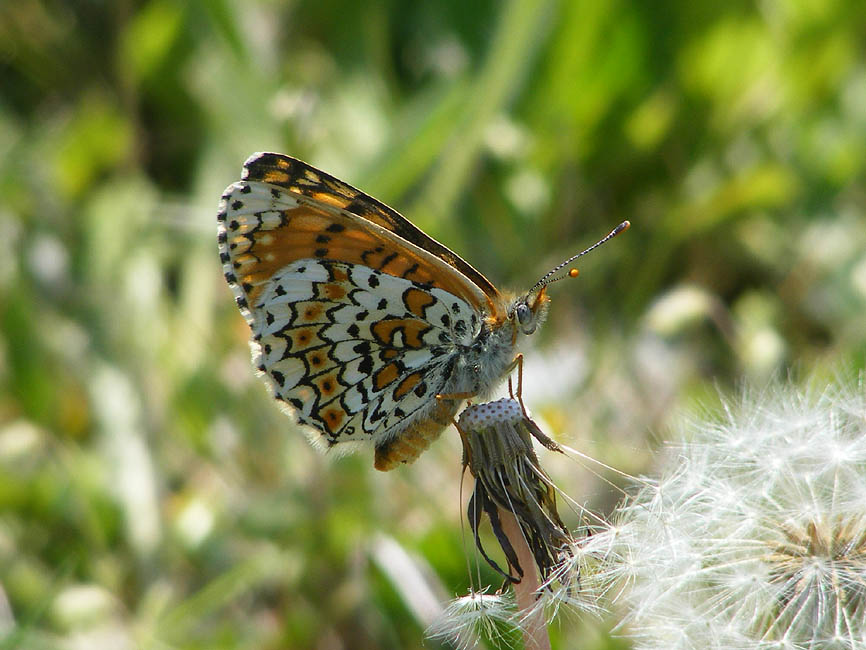
Showing posts with label Butterflies. Show all posts

Large Skipper - Ochlodes venatus


Scientific Name: Ochlodes venatus (syn O. sylvanus). The genus name means 'turbulent' and refers to the way these territorial butterflies will suddenly dash about.

English Name: Large Skipper.

French Name: La Sylvaine.

5 Key Characters:
  • a little larger than the other tawny (fauve) skippers (forewings 14 - 17 mm long).
  • underside of the hindwing is a greenish yellow marked by indistinct pale spots.
  • upperside of the male tawny orange with a broad brown border.
  • male has a thick black sex mark (emitting pheromones) on the upperside of the forewing.
  • upperside of the female is brown with tawny spots and forewing bases.
Lookalikes: Silver-spotted Skipper Hesperia comma, which has much more obvious, clearly defined, shining white underside spots. Thymelicus spp, which are plain on the underside and a bit smaller.

Habitat: Hedges, forest fringes and wooded grassland.

Flight Period: May-June-July-August-September.

Caterpillar: Small and green with a dark head, July - May, overwintering as a caterpillar.

Host Plant: Grasses (Flattened Meadow Grass Poa compressa, Wood Meadow Grass P. nemoralis, Tor Grass Brachypodium pinnatum, Cocksfoot Dactylis glomerata, Purple Moor Grass Molinia caerulea).

Status: Very common, widespread and abundant but the population is declining. A Grassland Indicator Species (that is, a species which is monitored to provide information about the health and sustainability of natural grasslands). This is a conspicuous and easy to see butterfly in the Touraine Loire Valley and Brenne.

Photographed by Loire Valley Nature:

All photos will be enlarged in a new window if you click on them. Row 1 left at La Croix-Sourd, near Chaumussay, June.


June 2015, on Baneberry Actaea spicata, La Bourgoterie (Chaumussay).


Swallowtail - Papilio machaon


Scientific Name: Papilio machaon.

English Name: Swallowtail.

French Name: Le Machaon or le Grand Porte-queue.

5 Key Characters:
  • a large butterfly (forewings 32 - 40 mm long).
  • yellow wings with black bars and lines.
  • hind wings extend to form a quite long tail.
  • prominent orange spot on the inner bottom corners of the hind wings.
  • black bordered grey and blue bands close to wing outer edges.
Lookalikes: Scarce Swallowtail Iphiclides podalirius, which is white, not yellow, with black 'tiger stripes'.

Habitat: Open places. They often engage in 'hill topping' ie gathering on elevated points, together with the Scarce Swallowtail. A great wanderer, so sometimes encountered in towns, in gardens, where it is attracted to Buddleia and has been recorded occasionally ovipositing on carrot leaves.

Flight Period: March-April-May-June-July-August-September-October.

Caterpillar: Large, green and black striped with orange spots, May - November. Overwinters as a chrysalis.

Host Plant: Umbel family Apiaceae (Fennel Foeniculum vulgare, Giant Fennel Ferula communis, Honewort Trinia glauca, Ptichotys saxifraga, Laserpitium gallicum, Peucedanum oreoselinum, Wild Carrot Daucus carota, Pepper Saxifrage Silaum silaus, Burnet Saxifrage Pimpinella saxifraga, Moon Carrot Seseli libanotis, S. montanum, Wild Angelica Angelica sylvestris).

Status: Very widely distributed and common but rarely abundant. A species that is easy to see in the Touraine Loire Valley and Brenne.

Photographed by Loire Valley Nature:

All photographs will enlarge in a new window if you click on them. Row 1 on a track on the perimeter of the Parc de Boussay, April. Left & centre nectaring at a Common Dog Violet Viola riviniana. Row 2 Left on a track on the perimeter of the Parc de Boussay, April. Centre & right in our orchard, May, nectaring on Red Clover Trifolium pratense. Row 3 - 4 in our orchard, May, nectaring on Red Clover Trifolium pratense.


Caterpillar on Wild Parsnip Pastinaca sativa.

Caterpillar on French Hogs Fennel Peucedanum gallicum.
Caterpillar on Wild Carrot Daucus carota in our garden, autumn.
A caterpillar in our orchard, September.


Map Araschinia levana


Scientific Name: Araschinia levana (Nymphalidae Nymphalinae).


English Name: Map (Brush-footed butterflies family, Tortoiseshells and Fritillaries sub-family).

French Name: La Carte géographique (='the cartographic map').


5 Key Characters:
  • underwings are purplish brown with a network of white tracery (resembling a map).
  • spring form is orange with strong black markings on upper side.
  • summer form is black with a central white band and a thin irregular dark red band near the wing edges on the upper side.
  • small to medium sized butterfly (wingspan 40 mm).
Lookalikes: Spring form might be mistaken for the Comma Polygonia c-album, but the Map doesn't have the irregular wing edges. Summer form might be mistaken for the Southern White Admiral Limenitis reducta, which is larger, blue-black and lacking the red line on top and coppery red and pure white underneath.


Habitat: Woodland edges, river and ditch banks with tall lush vegetation, open woodland, often damp. Extensive sunny damp patches of nettles. Sometimes hot dry slopes.


Flight Period: March-April-May-June-July-August-September.

Caterpillars: Black with tufts of orange hairs and tiny white dots. Food plant Nettle Urtica dioica, May - June and August - September. Overwinters as a chrysalis.


Status: Abundant.


Photographed by Loire Valley Nature:

Resting on bramble.
Summer form.
Spring form.
Spring form on caterpillar food plant Nettle Urtica dioica.

Small Copper Lycaena phlaeas

Scientific Name: Lycaena phlaeas (Lycaenidae Lycaeninae). 


English Name: Small Copper (Gossamer-winged butterfly family, Coppers sub-family). 


French Name: Le Bronzé (='suntanned'); le Cuivre commun (='common copper'). 


5 Key Characters:
  • small (29 - 35 mm wingspan).
  • orange red band on the upperside of the hind wings.
  • forewings tawny orange with dark markings.
  • hind wings a distinctive shape (with a little 'tail').
  • underside of the hind wings grey or beige, only faintly spotted. 

Lookalikes: Large Copper Lycaena dispar, which is much rarer, bigger and much more strongly spotted on the underside of the hind wing. Sooty Copper L. tityrus, which does not have a tail and has orange crescents along the edge of the hind wing, not a band.

Habitat: All sorts of open places, especially sandy places and sunny fallow agricultural land. Often seen with open wings angled to the sun. 


Flight Period: February-March-April-May-June-July-August-September-October-November. 

Caterpillar and Host Plant: Docks (Garden Sorrel Rumex acetosa, Sheeps Sorrel R. acetosella, R. intermedius, Fiddle Dock R. pulcher, French Sorrel R. scutatus).


Status: Very widely distributed and despite the population having declined by 50% since 1990, still abundant. A Grassland Indicator Species (monitored to provide a means of predicting the ecological health of natural grassland habitat). 


Photographed by Loire Valley Nature:

Note the very small spots on the underside of the hind wing.
 

Long-tailed Blue Lampides boeticus


Scientific Name: Lampides boeticus (Lycaenidae Polyommatinae).

English Name: Long-tailed Blue (Gossamer-winged butterfly family, Blues sub-family).

French Name: L'Azuré porte-queue (='tail bearing blue').


5 Key Characters:
  • medium sized (31 - 41 mm wingspan), large for a blue.
  • upperside of male violet blue narrowly bordered by brown; female dull brown washed with violet on the wing bases.
  • undersides grey brown marbled with white.
  • a white band across the underside of the hind wings.
  • long fine tail and a pair of black 'eyes' on each hind wing.

Lookalikes: None in this area.


Habitat: Open areas, vegetable gardens, urban green spaces.


Flight Period: March-April-May-June-July-August-September-October-November.

Caterpillar and Host Plant: Pea family (Common Bladder Senna Colutea arborescens, Broad-leaved Everlasting Pea Lathyrus latifolius, Garden Pea Pisum sativum, Green Bean Phaseolus vulgaris, Alfalfa Medicago sativa, Spanish Broom Spartium junceum). The caterpillars are cannibals, eating rivals until there is only one per plant. The caterpillar varies considerably, from green to purplish brown often with dark stripes.


Status: This is a cosmopolitan highly mobile and migratory species. Abundant in the south of France, its presence in the Touraine Loire Valley varies from year to year and depends on the migration. Curiously, it is being recorded less and less in this area, despite it being a species one would think would be benefitted by climate change.


Photographed by Loire Valley Nature:

Note the white band on the hind wing and the long 'tails'.

Green-underwing Blue Glaucopsyche alexis


Scientific Name: Glaucopsyche alexis (Lycaenidae Polyommatinae).

English Name: Green-underside Blue (Gossamer-winged butterfly family, Blues sub-family).

French Name: L'Azuré des cytises (='broom blue').


5 Key Characters:
  • extensive patch of turquoise blue on the base of the underside of the hind wings.
  • medium sized (wingspan 29 - 41 mm), large for a blue.
  • upper side of the male blue, bordered with black; female brown, sometimes with a blue wash on the base of the wings.
  • large black dots on the underside of the forewings but only a few small black spots on the underside of the rear wings.
  •  

Lookalikes: None in this area.


Habitat: Flower rich grassland on poor soil, dry grassland, woodland edges.


Flight Period: March-April-May-June-July.

Caterpillar and Host Plant: Pea family (Wild Liquorice Astragalus glycyphyllos, Prostrate Canary Clover Dorycnium pentaphyllum, Ribbed Melilot Melilotus officinalis, Alfalfa Medicago sativa, Black Medick M. lupulina, Spanish Broom Spartium junceum).

Status: Localised but can be abundant.

Photographed by Loire Valley Nature:

Glanville Fritillary Melitaea cinxa


Scientific Name: Melitaea cinxa.

English Name: Glanville Fritillary.

French Name: La Mélitée du Plantain.

5 Key Characters:
  • A series of black dots in the submarginal band that are visible on both sides of the lower wings.
  • Medium sized (front wing 15-20mm long).
  • Rich ochre colour with a black net pattern on the upperside.
  • Males often pose with their wings open on bare earth patches or the tips of tall grasses.
  • Very flighty, not easy to approach closely.
Lookalikes: Knapweed Fritillary Melitaea phoebe, which does not have black spots on the upperside of the lower wing and has a more banded appearance on the upperside, with the ochre varying from yellow to red.

Habitat: Poor, short grassland, fallow land and grassy banks.

Flight Period: April-May-June-July-August-September.

Status: Common. Widely distributed and abundant. This is a conspicuous and easy to see butterfly in the Touraine Loire Valley and Brenne.

Caterpillar: July - May, living communally when young. Overwinters as a caterpillar in a silk group nest. The red head and black body makes the mature caterpillar easily identifiable. Young caterpillars are pale ochre with a dark head, greatly resembling the flower buds of the host plant Ribwort Plantain. You can often find the caterpillar nests in crop margins and along rural tracks colonised by Plantains.

Host Plant: Ribwort Plantain Plantago lanceolata (Plantain lancéolé) and Greater Plantain P. major. Sometimes Speedwells Veronica spp (les Véroniques)

More Info:
Glanville Fritillary Melitaea cinxa caterpillars
How to distinguish Knapweed and Glanville Fritillaries

Photographed by Loire Valley Nature:

Photographs number left to right and top to bottom. 1-5 Caterpillars in February (note nest). 6-9 Caterpillars in March. 10 female (note the tip of her genitalia is just visible under her abdomen near end). 11-14 in our orchard, April. 12 female genitalia (possibly a sperm plug inserted by the male after mating, but the image isn't good enough to be sure). 13 - 22 & 26 on Hedgerow Cranesbill Geranium pyrenaicum in our orchard, May. 13 - 14 & 17 - 18 a female. 17 female on the left, joined by a male flying in on the right. 23 - 25 on Red Clover Trifolium pratense in damp improved pasture in the Brenne, May.


Nectaring on Wild Oregano Origanum vulgaris (Gatekeeper Pyronia tithonus to right).

Nectaring on Wild Oregano Origanum vulgaris (female Gatekeeper Pyronia tithonus above).

Nectaring on Wild Oregano Origanum vulgaris.

Nectaring on Wild Oregano Origanum vulgaris.

Nectaring on Wild Oregano Origanum vulgaris.

Nectaring on Wild Oregano Origanum vulgaris.

Nectaring on Wild Oregano Origanum vulgaris.

Nectaring on Wild Oregano Origanum vulgaris.

Nectaring on Wild Oregano Origanum vulgaris.

Nectaring on Wild Oregano Origanum vulgaris.

Nectaring on Wild Oregano Origanum vulgaris.

Nectaring on Wild Oregano Origanum vulgaris.

Nectaring on Wild Oregano Origanum vulgaris (and about to be monstered by a Honey Bee Apis mellifera).

Nectaring on Wild Oregano Origanum vulgaris.
Caterpillars, in their cobweb protection near the host plant Ribwort Plantain Plantago lanceolata, February.
Caterpillars in their silken nest. Note the red heads.