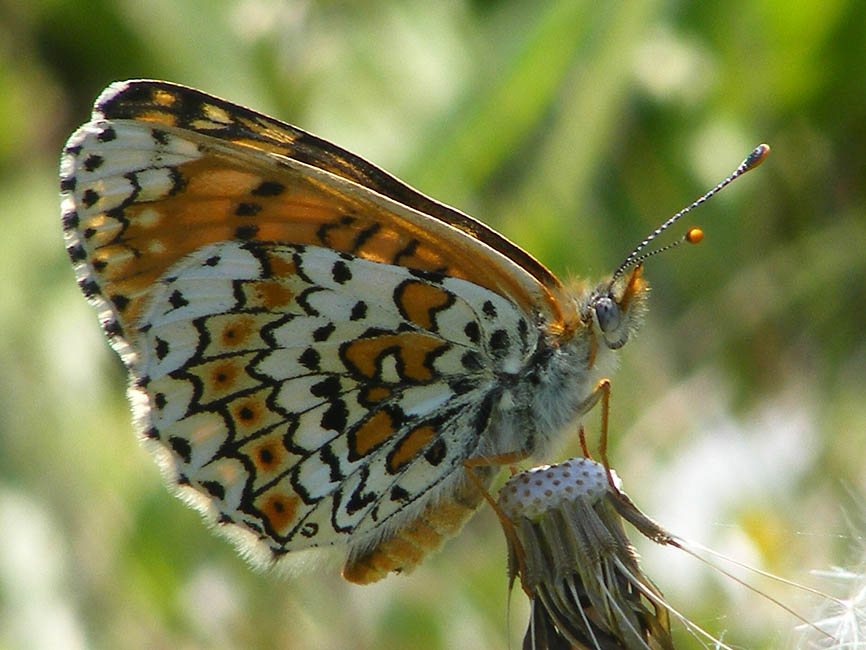
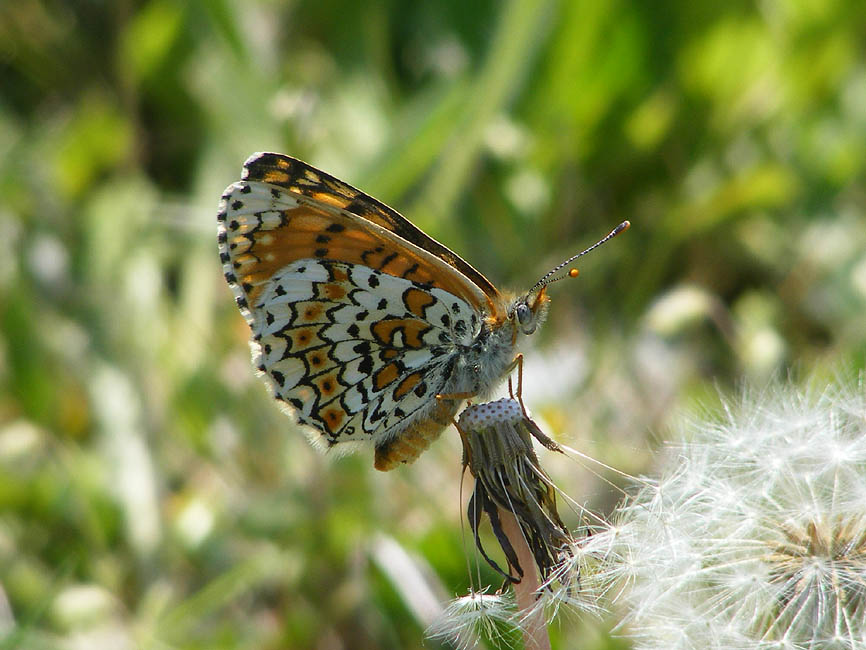
A series of black dots in the submarginal band that are visible on both sides of the lower wings.
Medium sized (front wing 15-20mm long).
Rich ochre colour with a black net pattern on the upperside.
Males often pose with their wings open on bare earth patches or the tips of tall grasses.
Very flighty, not easy to approach closely.
Lookalikes:Knapweed FritillaryMelitaea phoebe, which does not have black spots on the upperside of the lower wing and has a more banded appearance on the upperside, with the ochre varying from yellow to red.
Habitat: Poor, short grassland, fallow land and grassy banks.
Status: Common. Widely distributed and abundant. This is a conspicuous and easy to see butterfly in the Touraine Loire Valley and Brenne.
Caterpillar: July - May, living communally when young. Overwinters as a caterpillar in a silk group nest. The red head and black body makes the mature caterpillar easily identifiable. Young caterpillars are pale ochre with a dark head, greatly resembling the flower buds of the host plant Ribwort Plantain. You can often find the caterpillar nests in crop margins and along rural tracks colonised by Plantains.
Host Plant: Ribwort Plantain Plantago lanceolata (Plantain lancéolé) and Greater Plantain P. major. Sometimes Speedwells Veronica spp (les Véroniques) More Info:Glanville Fritillary Melitaea cinxa caterpillars Glanville Fritillary Melitaea cinxa caterpillars Glanville Fritillary Melitaea cinxa caterpillars How to distinguish Knapweed and Glanville Fritillaries Photographed by Loire Valley Nature:
Photographs number left to right and top to bottom. 1-5 Caterpillars in February (note nest). 6-9 Caterpillars in March. 10 female (note the tip of her genitalia is just visible under her abdomen near end). 11-14 in our orchard, April. 12 female genitalia (possibly a sperm plug inserted by the male after mating, but the image isn't good enough to be sure). 13 - 22 & 26 on Hedgerow Cranesbill Geranium pyrenaicum in our orchard, May. 13 - 14 & 17 - 18 a female. 17 female on the left, joined by a male flying in on the right. 23 - 25 on Red Clover Trifolium pratense in damp improved pasture in the Brenne, May.
Nectaring on Wild Oregano Origanum vulgaris (GatekeeperPyronia tithonus to right).
Nectaring on Wild Oregano Origanum vulgaris (female GatekeeperPyronia tithonus above).
Nectaring on Wild Oregano Origanum vulgaris.
Nectaring on Wild Oregano Origanum vulgaris.
Nectaring on Wild Oregano Origanum vulgaris.
Nectaring on Wild Oregano Origanum vulgaris.
Nectaring on Wild Oregano Origanum vulgaris.
Nectaring on Wild Oregano Origanum vulgaris.
Nectaring on Wild Oregano Origanum vulgaris.
Nectaring on Wild Oregano Origanum vulgaris.
Nectaring on Wild Oregano Origanum vulgaris.
Nectaring on Wild Oregano Origanum vulgaris.
Nectaring on Wild Oregano Origanum vulgaris (and about to be monstered by a Honey BeeApis mellifera).
Nectaring on Wild Oregano Origanum vulgaris.
Caterpillars, in their cobweb protection near the host plant Ribwort Plantain Plantago lanceolata, February.
Caterpillars in their silken nest. Note the red heads.
Are There Bats in the Loire Valley?
-
Yes there are! Most of the famous Chateaux are very proud to be hosting
multiple species of micro bat. Some of them, like Chambord, host hundreds
of bats...

 5 Key Characters:







No comments:
Post a Comment