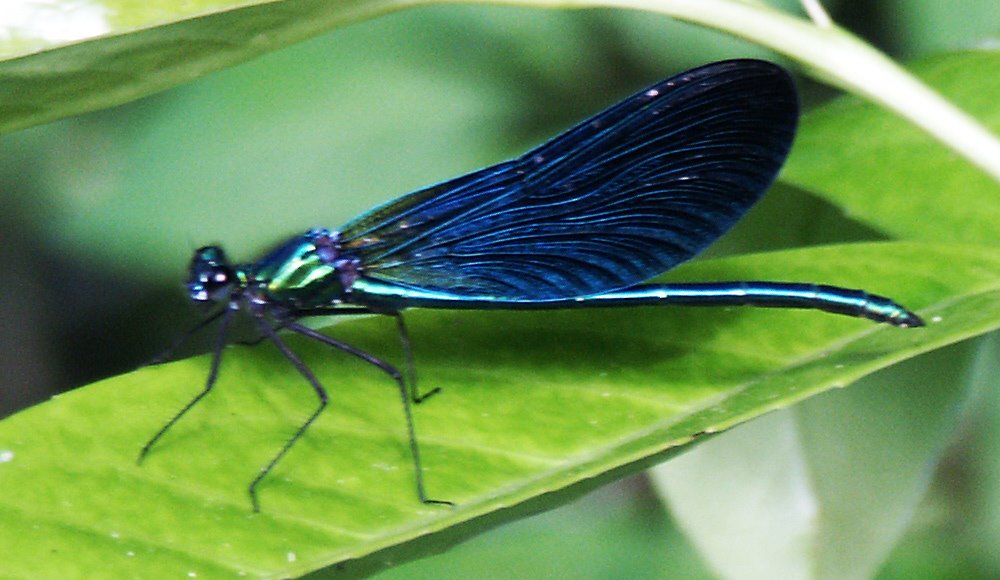
Showing posts with label Dragonflies. Show all posts

Large Pincertail Onychogomphus uncatus


Scientific Name: Onychogomphus uncatus (Gomphidae).

English Name: Large Pincertail (Clubtails and pincertails family).


French Name: Le Gomphe à crochets (='the Gomphid with hooks').


5 Key Characters:
  •  males have yellow pincers at the end of their abdomens.
  • no yellow stripe between the eyes.
  •  
  •  
  •  
Lookalikes: Other Gomphids, especially Small Pincertail Onychogomphus forcipatus. This is the only place in Europe where so many Gomphids can be seen in the same area.


Habitat: Smaller, shady streams.


Flight Period: June-July-August-September.


Status: Rare.


Photographed by Loire Valley Nature:

Western Clubtail Gomphus pulchellus


Scientific Name: Gomphus pulchellus (Gomphidae).

English Name: Western Clubtail (Clubtails and pincertails family).

French Name: Le Gomphe joli (='the pretty Gomphid').


5 Key Characters:
  •  
  •  
  •  
  •  
  •  

Lookalikes: Other Gomphids. Nowhere else in Europe can so many species of Gomphid be seen in the same area.

Habitat: Slow flowing and still rivers.

Flight Period: May-June-July.

Status: Common.

Photographed by Loire Valley Nature:

Western Willow Spreadwing Lestes viridis


Scientific Name: Lestes viridis. Syn. Chalcolestes viridis (Lestidae).

English Name: Western Willow Spreadwing; Willow Emerald Damselfly (Spreadwing family).

French Name: Le Leste vert (='green spreadwing').


5 Key Characters:
  • metallic green with no blue pruinosity (dusting).
  • (black tipped) pale (white) appendages (at end of abdomen).
  • large and long for a spreadwing (39 - 48 mm long, wingspan 49 - 59 mm).
  • large pale creamy brown pterostigmata (the opaque coloured cell on the leading edge of the wings near the tip) surrounded by dark veins.
  • spur shaped mark on side of thorax bordering the metallic green above.

Lookalikes: Tenerals (newly emerged) of other spreadwings, especially Small Spreadwing L. virens, before their pterastigmata darken and their blue pruinosity (dusting) develops. However, they don't have the spur shaped mark on the thorax.

Habitat: Trees and bushes, often a long way from water and in the shade, especially if it is hot. Any still or slow moving water with overhanging trees or bushes. Ponds, étangs, lakes, canals, oxbows, water courses so long as they are unpolluted. Females lay their eggs in willow Salix spp and alder Alnus spp twigs overhanging the water and the larvae fall into the water (if they miss and land on the bank they can wiggle their way to the water). They are particularly susceptible to predation by fish so if you want them breed successfully in your garden pond, don't stock with fish. The 'tracks' left by egglaying are visible and can be as much as 3 metres above the water.

Flight Period: May-June-July-August-September-October-November-December.


Status: Widespread and common. Benefits by urbanisation as it favours garden ponds and avoids seasonal bodies of water.

Photographed by Loire Valley Nature:

Female, lurking about in the bushes.

Rural Tracks

Throughout France there is a network of variously named public rights of way. One of the most frequently encountered by walkers is the chemin rural (plural chemins ruraux). These are (usually) unpaved tracks owned and maintained by the local commune. They are almost always ancient laneways, winding through farms and today used by walkers, horse riders, hunters and farmers. Sometimes they are unmarked, but usually they have a small sign at either end with the letter R, C or V and an a number to identify them. They also frequently have the standardised walking trail symbols posted along them and appear on maps as part of the national hiking trail (randonnée) network. Even when they appear to be private farm tracks, the public is permitted to walk them. Walking them in all seasons is a great way to get to know the wildlife of this area, as they are usually long thin grasslands bordered by hedges, woodland or agricultural land, and sometimes even aquatic habitats such as streams, ditches, springs and ponds. You are unlikely to meet another person on most of them.

A chemin rural near Yzeures sur Creuse, October.
A notice issued by the local authority who has responsibility for maintaining this chemin rural, stapled to a trackside tree. It says that motorised vehicles are not permitted on this track between October and May ie the months when it is likely to be wet. The commune very sensibly does not want the track churned up and ruined by hunters' vans or farm machinery.
Bird watching in the Brenne down a track near la Maison du Parc.

Bird watching in the Brenne, near l'Etang vieux. This track had a sign temporarily banning agricultural vehicles because it was flooded, however that didn't stop anyone on foot who was prepared to take off their boots and slosh.
The sign on this track in the Brenne says 'Attention. Track under repair. Do not tow vehicles down it.' There was no problem (apart from ankle deep water) in walking down it.
A track through the bocage country along the River Vienne near Chinon.
A track through arable crop land and forest. This is one of my butterfly transects.


Ruddy Darter Sympetrum sanguineum


Scientific Name: Sympetrum sanguineum (Libellulidae).

English Name: Ruddy Darter (Darters, Skimmers and Chasers family).


French Name: Le Sympétrum rouge sang (='blood red darter').


5 Key Characters:
  • black legs (no yellow).
  • mature males are very red, with red faces, no distictive markings on the thorax and a slightly clubbed abdomen; females are yellowish with black spots down the sides.
  • wings have a small but obvious area of yellow at the base. 
  • a small dragonfly (35 - 40 mm long, wingspan 50 - 60 mm).
  • bouncy, darting flight.
Lookalikes: Spotted Darter Sympetrum depressiusculum, which is very rare and has a more orange abdomen with pairs of black spots and no red face.


Habitat: Often at eutrophic or brackish permanent ponds (marshes, ponds, étangs, lakes, oxbows, fens, former gravel pits, overflow ponds and still parts of water courses), but sometimes also seasonal swamps and flooded pasture. Likes lush aquatic vegetation such as reeds and sedges. Avoids running or acidic water. Not very territorial and a number can be seen gathered together but maintaining a distance of a couple of metres from each other.


Flight Period: April-May-June-July-August-September-October-November.


Status: Very common.

Photographed by Loire Valley Nature:

Female, caught in a survey of the Réserve Naturelle de la Chérine, the LPO site in the Brenne.

Moustached Darter Sympetrum vulgatum


Scientific Name: Sympetrum vulgatum (Libellulidae).


English Name: Moustached Darter. Also Vagrant Darter. (Chasers, Skimmers and Darters family.)


French Name: Le Sympétrum vulgaire (='the common darter').


5 Key Characters:
  • the black on the frons (between the eyes) extends along the front edge of the eye (like a drooping moustache).
  • the thorax is brown, with no really obvious markings.
  • a medium sized dragonfly, 35-40mm long with a wingspan of 55mm.
  • mature males have a brick red abdomen, slightly club shaped.
  • legs striped black and yellow.

Lookalikes: Darters Sympetrum spp are never easy to tell apart. Ideally you need a good view of the moustache to confidently identify this species.


Habitat: Shallow standing water (ditches, ponds, étangs, lakes, oxbows, former gravel pits and quarries that have flooded) with fairly lush vegetation. A strong flyer that often migrates. Often seen perched on bushes, stones or bare earth on banks, but also in sheltered places far from water, especially in the autumn, when old individuals may be spotted warming themselves up in sunny woodland clearings.


Flight Period: June-July-August-September-October-November.


Status: Locally common in the Brenne, not common in the Touraine. They are not threatened in the Touraine, but have just never been very common as it is on the western edge of their range.


Photographed by Loire Valley Nature:

Dainty Bluet Coenagrion scitulum


Scientific Name: Coenagrion scitulum (Coenagrionidae).

English Name: Dainty Bluet; Dainty Damselfly (Narrow-winged or Pond Damselfly family).


French Name: L'Agrion mignon (='dainty bluet').


5 Key Characters:
  • long pale pterostigma (the opaque cell near the tip on the leading edge of the wing).
  • the distinctive black mark on segments 1-2 looks like a long eared cat (ahem...use your imagination a bit), a tuning fork or a thick U on a short stalk.
  • segments 3-5 are half black, segments 6-7 are all black in males. 
  • black markings on the abdomens of females are torpedo shaped.
  • blue and black (females can be greenish).

Lookalikes:  Other Bluets, which have different patterns of black and smaller, darker, more equal sided pterostigmas. More common than the Mercury Bluet C. mercuriale, less common than the Azure Bluet C. puella, but can be seen in the same places flying together, so care is needed.


Habitat: Still stagnant or slow flowing water with lots of aquatic vegetation and sun eg old ponds, the weedy 'tails' of étangs, permanent marshes, occasionally artificial bodies of water that have been taken over by invasive plants. The species is not always easy to see as they are small and tend to stay out on the aquatic plants.


Adult Flight Period: May-June-July-August.


Status: Common in the Brenne. Widespread in central and western France.


Photographed by Loire Valley Nature:

Blue Featherleg - Platycnemis pennipes


Scientific Name: Platycnemis pennipes.

English Name: Blue Featherleg or White-legged Damselfly.

French Name: L'Agrion a larges pattes (='wide legged agrion').

5 Key Characters:
  • middle and hind tibias white, wide, flattened and 'feathered', especially in the males.
  • mature specimens have a continuous black line up their legs.
  • mature males are pale blue with black markings, immatures are porecelain white.
  • females are light browny green with black markings, immatures are light pinky brown.
  • they have a double set of 'shoulder' stripes (antehumerals).
Lookalikes: Immature males are often mistaken for the White Featherleg P. latipes, but that is a rare species in this area and does not have a black line up the leg. Immature females can be confused with both P. latipes and the Orange Featherleg P. acutipennis, however this last species is very localised (ie only occurring on certain sites) and it seems that although P. acutipennis and P. pennipes distributions overlap they do not co-exist - sites either have one or the other. This is at least partly connected to different habitat requirements and/or tolerances.

Habitat: Floodplains, especially oxbow lakes, rivers and open stretches of flowing water. They dominate suitable sunny streams but here in the lowlands will also use still water such as neutral or alkaline lakes, fish ponds (étangs), gravel pits and canals. The species never uses acidic waters such as in peat bogs. Both sexes are commonly encountered in grassland quite a distance from any water.

Flight Period: May-June-July-August-September-October.

Status: By far the most common Featherleg, it is ubiquitous, often abundant and one of the last species to disappear from areas of intensive agriculture. It is a temperate climate species, ideally suited to the French central lowlands where it is neither too hot nor too cold.

Photographed by Loire Valley Nature:

Photographs numbered from left to right and top to bottom. All photos can be enlarged in a new window by clicking on them. 1, 5-6 immature females, 2-4 mature males, in our orchard, May.


A group ovipositing in a calm shallow section of the Creuse river at Fontgombault in the Brenne. The males 'stand guard' over the females, who they have grasped by the scruff of the neck with the claspers at the tip of their abdomen. They look like circus acrobats.


Small Rivers

The Loire valley is in fact a river system, and includes many rivers which flow into the Loire. Feeding these tributaries in turn is a network of small rivers, such as the Claise, Aigronne and Echandon.

These small rivers tend to have a considerable fall over their length, usually about .75m per kilometre. This means that they are ideal for powering water driven mills, and as a consequence the rivers are controlled by weirs (barrages in French) to create header ponds. The flow is then diverted down a mill stream (bief in French), creating an island. The mill may be situated on the island or on the bank. Very few of these mills now function, but property owners are responsible for maintaining and operating the sluices as necessary to control flow and levels.

Mills have been sited at roughly 1km intervals on these rivers since about the 12th century, and the ecology of these small rivers and mill streams is now dependent on the controls associated with the mill workings. The many weirs make the rivers seem bigger than they actually are, and slow the flow down. Although these rivers are weired, they are rarely canalised, and the banks are well vegetated. In recent decades, the banks of these small rivers have become more and more overgrown, restricting access to the rivers, and causing difficulties in the dispersal of riparian species into the wider landscape (eg emerging dragonflies).

As part of a new river management scheme, overseen by local river technicians, the riverbank vegetation is being systematically thinned and the over abundant poplars removed. In some places weirs are being removed in order to speed up flow and ensure the water is better oxygenated. This is proving rather controversial, as the principle beneficiaries are the angling clubs, who sometimes do not see the wider ecological picture.

Water quality is generally good, although in many places water meadows have been ploughed up. This practice, and those such as intensive dairy farming mean that the water is periodically polluted by silt and agricultural runoff of one sort or another.

There are some problems with the invasive alien species Water Primrose Ludwigia spp (jussie in French). This aquatic plant rapidly covers the surface of still or slow moving water, out competing native plants, blocking out light, causing an accumulation of organic material and interfering with the breeding of fish and aquatic insects. The river technicians are dealing with this by manually weeding.

There are also problems with the invasive alien species Coypu Myocaster coypus, whose burrows undermine river banks. The animals have been declared vermin (nuisible in French) and landholders have an obligation to notify the authorities and eradicate animals.

For an overview of the management programme for the Claise River, see Une Belle Riviere, a blog post (in English) on Days on the Claise.
A millpond on the Claise River in Preuilly sur Claise. Taken from the top of the weir/sluice, the mill is down a channel to the left. I have been told that the deep slow waters here are home to a silure, an enormous non-native catfish which has eaten every other living creature in the pool including birds such as moorhens and coots. The fish is reported to be at least a metre long.

The Claise, typical of the small Tourangelle rivers, here in December swelled by winter rain and just bursting its banks. The island to the left is formed by the remains of a medieval bridge, the weir in the distance creates a mill pond for the Moulin de Chanvre ('Hemp Mill') and the millstream is the channel going off to the right. The photograph was taken from the boat ramp and this is a good spot for watching Banded Demoiselle Calopteryx splendens and Black-tailed Skimmer Orthetrum cancellatum in the summer.


Beautiful Demoiselle - Calopteryx virgo


Scientific Name: Calopteryx virgo.

English Name: Beautiful Demoiselle.

French Name: Le Caloptéryx vierge.


5 Key Characters:
  • the wings of males wide, paddle shaped and more or less entirely dark purplish or greenish blue.
  • underneath the last 3 segments on the male's abdomen (known as their 'tail light') orangey or browny red.
  • large and robust for a damselfly (45 - 49 mm long).
  • male bodies dark metallic blue, female bodies bronzy green.
  • female wings broad and distinctly tinted golden brown.
Lookalikes: Banded Demoiselle C. splendens, which has narrower wings. Male C. splendens have yellowish 'tail lights' and only partially dark blue wings. Females are very difficult to distinguish in the field, but C. virgo has more strongly tinted wings and the yellow lateral suture is bayonnet shaped, not an exclamation mark like C. splendens. The lateral suture (on the side of the thorax) can be seen if you have a good photograph. The white pseudopterastigma (near the wing tip) of female C. virgo is closer to the node (in the middle of the leading edge). The distance between the pseudopterastigma and the wingtip should be less than 4 times the distance between the node and the pseudopterastigma. They also prefer different habitats, with C. virgo choosing shadier, faster running streams. Both species have a number of subspecies which are sometimes capable of interbreeding with each other or with the parent species. The local subspecies is C. virgo meridionalis, with males that always have coloured tips to the wings, but the wing bases might be clear for a bit more than 5 mm.

Habitat: Small fairly fast running woodland streams, especially if in steep sided valleys with some sunny spots. The small streams feeding acidic lakes in the Sologne. They avoid large water courses and are highly intolerant of organic pollution. Adults perch on bankside trees and vegetation. Males are territorial and flick their wings to attract females or repulse other males.

Flight Period: April-May-June-July-August-September-October.

Status: Fairly common although they are considerably threatened by modern agricultural practices and 'improvements' to water courses. The complete suppression of bankside trees and bushes and the slashing of vegetation should be avoided if the species is to remain.

Photographed by Loire Valley Nature:

Photographs are numbered from left to right and top to bottom. All photos will enlarge into a new window if you click on them. 1 two male Calopteryx sp. Top right is C. virgo, bottom left is C. splendens - a relatively uncommon example of the two species sharing a habitat, in this case sitting on a Black Alder Alnus glutinosa on the banks of a bief (millstream) in the Aigronne Valley, May. 2 female, Aigronne Valley, May. Note the short bayonnet shaped lateral suture (the yellow mark on the side of the thorax) and the wide golden brown wings. Using Photoshop, the distance between the node and the pseudopterastigma has been calculated as 4 times the distance from the tip to the pseudopterastigma - just on the limit of the ratio acceptable for C. virgo.


A male lands on my boot along the millstream (Fr. bief) in Le Petit Pressigny.

Courtship, female on twig, male flying, above a small stream near Panzoult.

White-tailed Skimmer Orthetrum albistylum


Scientific Name: Orthetrum albistylum (Libellulidae).

English Name: White-tailed Skimmer (Chasers, Skimmers and Darters family).

French Name: L'Orthétrum à cercoïdes blancs (='white appendaged skimmer'); l'Orthétrum à stylets blancs (='white stylused skimmer').

5 Key Characters:
  • white appendages on the tip of the abdomen.
  • black pterostigmas (the coloured cell on the leading edge of each wing, near the tip).
  • pale stripes on the thorax, including an obvious mid-line running between the wings.
  • pale washed out colours (males blue, females yellowish).
  • males have black tips to their abdomen (with white appendages).

Lookalikes: Black-tailed Skimmer O. cancellatum, which is more robust and darker, with black appendages.


Habitat: Stillish warm open ponds, étangs and lakes. Also gravel pits, oxbows, millponds, ditches and canals. Tolerates eutrophic (nutrient polluted) water.

Flight Period: May-June-July-August-September.


Status: Common in the Brenne and south of the Loire. Has been extending its range northwards since the beginning of the 20th century. A pioneer species of new sites, but often pushed out by Black-tailed Skimmer after establishing a population. Always less abundant than the Black-tailed Skimmer. Intensive fish farming is detrimental to the species.


Photographed by Loire Valley Nature:

Female.


Variable Bluet Coenagion pulchellum


Scientific Name: Coenagrion pulchellum (Coenagrionidae Coenagrion).

English Name: Variable Bluet; Variable Damselfly (Bluetail family Eurasian Bluets group).

French Name: L'Agrion gracieux (='the fierce graceful'); l'Agrion joli (='the pretty fierce').


5 Key Characters:
  • males have blue exclamation marks on 'shoulders'.
  • males have a black Y shape on the base of the abdomen (segments 1-2).
  • males are deep blue with a lot of black (abdominal segments 4-5 at least half black for example).
  • females greeny blue and black and very variable.
  • pronotum (segment between the head and thorax) has an M shaped rear edge.

Lookalikes: Azure Bluet C. puella, which is more abundant, not as dark, with 'shoulder' stripes unbroken and a U shaped mark at the base of the abdomen.

Habitat: Still, sunny, non-acidic, often eutrophic water such as oxbows, ponds, étangs, flooded ditches, permanent marshes and fens with well developed aquatic vegetation, often in forest clearings or bogs. They avoid polluted water or artificial ponds. Etangs which are farmed too intensively, especially for carp, are not used. They need marshy edges to the ponds and not too dense a growth of bushes on the banks.


Flight Period: May-June-July-August.

Status: Common in the Brenne, but generally scarce.


Photographed by Loire Valley Nature:

Small Spreadwing Lestes virens


Scientific Name: Lestes virens subsp vestalis (Lestidae).


English Name: Small Spreadwing; Late Spreadwing; Small Emerald Damselfly (Spreadwing or Emerald Damselfly family).


French Name: Le Leste verdoyant (='the Verdant robber').


5 Key Characters:
  • smallest and most delicate of the spreadwings.
  • back of head is yellow underneath.
  • male abdominal segments 9-10 blue.
  • no blue on male abdominal segments 1-2.
  • pterastigma (opaque coloured cell near wingtips) pale brown.
Lookalikes: Other spreadwings, especially Migrant Spreadwing Lestes barbarus, which does not have blue on the abdomen.


Habitat: Shallow reedy waters that dry out seasonally, especially in heathy areas.


Adult Flight Period: June-July-August-September-October-November.


Status: Widespread and common, but rarely the dominant spreadwing species.


Photographed by Loire Valley Nature:

Male.
Male.


The Loire River

The Loire is the longest river in France and divides the country into north and south. The Loire Valley is in fact a large river system, with many major rivers feeding into the Loire, mostly flowing from south to north to meet the Loire.The Loire is a fleuve in French, meaning it exits into the sea (beyond Nantes, into the Atlantic).
The Loire at Amboise -- deep and deceptively fast flowing.
The Loire was once navigable along much of its length, but in the 20th century the river trade began to decline and after the Second World War, no attempt was made to clear the river of the debris of bombed out bridges and the like. Within the area covered by this website there are no controls such as weirs, dams or locks on the Loire and it is allowed to run freely between generously spaced levee banks that prevent habitation and agricultural land from being flooded, without canalising the river. The water level in the river rises and falls with the seasons and weather conditions, flowing fast and deep in the winter and becoming shallow with many exposed gravel banks in the summer.
A sand bank at Montlouis sur Loire.
The natural flow of the river creates several adjunct habitats -- islands, shallow swift flowing water, deep slow flowing pools, sand banks, riparian forest, oxbow lakes, calcareous grassland, limestone cliffs and water meadows, forming an important mosaic with high biodiversity. You can find aquatic, grassland and woodland species along the river in close proximity. The mid stream sand and gravel banks offer important safe haven for nesting birds such as terns, gulls, curlews and plovers. The oxbows host beaver, herons and egrets, grass snakes Natrix spp and damselflies. The riverside forests shelter orioles, ospreys, emperor butterflies and large longhorn beetles. In the meadows you can find fritillaries and orchids. The levee banks are home to wasp spiders, broomrapes, pipits and a different suite of orchids.

An uprooted tree forms an obstruction which will cause sediment to build up behind it, changing the flow and providing new, if temporary habitat.
The river is marketed as 'the last wild river in Europe', and it is managed more or less as a long thin nature reserve. The sand and gravel is allowed to erode and shift about the river bed according to the natural flow of the river and this adds greatly to the river's value as a natural habitat, with a natural cycle of constant change and habitat succession.

The Loire at Montlouis.
Not much is left of the old riparian forest. Most of it has been cleared to make way for hay meadows or worse, poplar plantations. However, the meadows can be high quality habitat, if they have not been 'improved'. The world's largest population of the rare Snakeshead Fritillary Fritillaria meleagris grows in the water meadows along the Loire near its confluence with the Vienne, west of Chinon. These meadows are often divided up into bocage style pasture with hedgerows, sometimes very old.

Small Man-made Lakes - Etangs

This area, particularly the Brenne and the Sologne, abound in small man-made lakes or ponds called étangs in French. There are thousands of them, many created in the Middle Ages, but many from more modern attempts to drain the naturally boggy land and create commercial fish farms. These étangs provide a significant habitat for birds, reptiles (Pond Terrapins, snakes), amphibians (frogs, newts), dragonflies and aquatic plants.

These étangs are open deep water along one end, where there is an earth dam wall with a sluice to control overflow. The other end, where the water often enters via a small natural stream, forms a shallow tail of reedbeds and willow scrub. Beyond the reeds, in the water, are waterlilies and other truly aquatic plants. Bog plants growing along the tail of the étang include sedges, Clubrush, Bulrush, Branched Bur-reed, Yellow Iris and Marsh St Johns Wort.

Put together these étangs form wetland zones of similar significance to the better known Camargue or Baie de Somme. This is an ever changing landscape however. Every year in the late autumn many of the étangs are drained to harvest the fish. This practice also offers the opportunity to eradicate invasive species such as Water Primrose. Draining the lakes means that the rich mud, full of food for wading birds, is exposed.

The lakes are refilled either by water draining in off the surrounding land, or as part of a cascade of linked étangs which are emptied in sequence so all but the last is refilled by water coming down from the next. The fluctuating state of individual lakes and their close proximity to one another mean that the wildlife tends to migrate from one to another as conditions change.

The well vegetated étang at the Maison du Parc, the Brenne.
L'Etang de la mer rouge in the Brenne, overflowing across the dam wall. Unusually, this very large étang is not controlled by a sluice, but the overflow is directed into a nearby small étang.

L'Etang vieux, well vegetated and run as a nature reserve in the Brenne.
The reedbed and willow scrub tail of l'Etang vieux in the Brenne.
xxxxx
Bird watching in the Brenne, at the étang by the Maison du Parc, in May.

Keeled Skimmer - Orthetrum coerulescens


Scientific Name: Orthetrum coerulescens (Libellulidae).


English Name: Keeled Skimmer (Chasers, Skimmers and Darters Family).


French Name: L'Orthetrum bleuissant (='the blueing skimmer').

5 Key Characters:
  • small to medium sized skimmer (36 - 45 mm long), about the size of one of the larger darter spp eg Common Darter Sympetrum striolatum.
  • long yellow pterostigma (the opaque mark towards the tip of the wing on the leading edge).
  • mature males have entirely pruinose (dusty blue) abdomens (no black tip) and usually brown thoraxes (not blue).
  • slender tapering abdomen.
  • face brown (never pale blue or white).
Lookalikes: Other Orthetrum spp, especially Southern Skimmer O. brunneum (but males of this species have a blue face and thorax). See this post on Days on the Claise to check out the differences between the local species of skimmer.


Habitat: Streams and flowing ditches as well as springs and seeps. Sometimes stagnant water or flooded gravel pits or quarries.


Flight Period: April-May-June-July-August-September-October-November.


Status: Widespread but localised (ie only occurring in places that particularly suit it, not everywhere and not common). It is threatened by modern ditch cleaning operations, the drying out of marshland and eutrophication of water (pollution by organic matter). On the other hand, new ditches dug to drain bogs and marshes can benefit the species temporarily.


Photographed by Loire Valley Nature:

Broad Bodied Chaser - Libellula depressa


Scientific Name: Libellula depressa.

English Name: Broad Bodied Chaser.

French Name: La Libellule déprimée.

5 Key Characters:
  • very broad flat abdomen.
  • mature males have blue abdomens, females have yellowy brown, edged with yellow crescents.
  • base of hind wings have a large black patch and forewings have a smaller black mark at the base.
  • large (39 - 48 mm long).
  • thick whitish stripes on the 'shoulders' (antehumeral stripes).
Lookalikes: Other Libellula or Orthetrum spp, but none have such a wide abdomen.

Habitat: Often the first species to adopt newly created habitat, but once the vegetation grows up around a new water body they will be present in much lower numbers. A wide range of still (or nearly still) waters, especially if they are small, shallow, sunny and open with lots of bare earth eg. stock watering pools, lakes in disused quarries or other similar situations, marshes, ditches, ponds, fish ponds (étangs), lakes, oxbow lakes, calm parts of large water courses. They will tolerate eutrophic conditions (waters polluted by high levels of organic matter) and other types of slightly polluted or brackish water. When it is sunny males sit out on dry stems or bankside bushes, aggressively darting out to challenge and chase off rivals.

Flight Period: April-May-June-July-August-September. In flight they zoom about, 'starfighter' style.

Status: One of the commonest species.

Photographed by Loire Valley Nature:

All photos will enlarge in a new window if you click on them. Row 1 - 3 juvenile females congregating in bushes along a wooded farm track in the Brenne, May. Row 4 left as previous row; centre male on the fringes of the Parc de Boussay, quite a long way from water, June; right an aged male at the étang de la Rolle in the Foret de Preuilly, June. Row 5 left Libellulid dragonfly emerging (probably a Broad-Bodied Chaser), at the Etang de la Rolle in the Foret de Preuilly, June; centre left & right, right empty Libellulid exuviae (nymph cases), probably Broad-Bodied Chaser, at the Etang de la Rolle in the Foret de Preuilly, June. Row 6 as Row 5 left.


Female, May, in vegetation by an étang near la Maison du Parc, the Brenne.


Female.

Female.